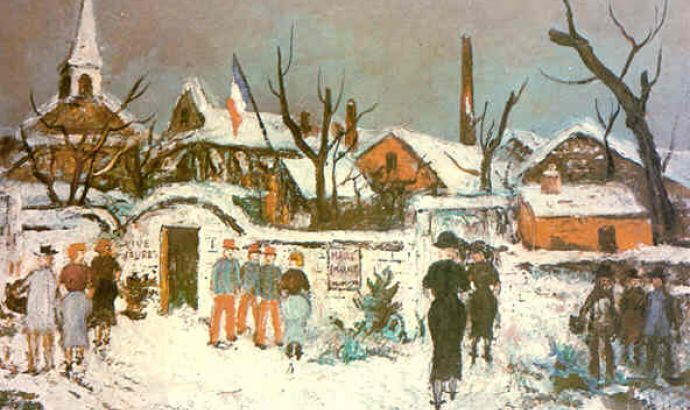
Maurice Utrillo- Humble Beginning of the Untrained Artist

Maurice Utrillo, the French artist, was best known for his naïve yet absolutely picturesque cityscapes. His paintings were rendered in thickly troweled paint. Maurice portrayed some of the most celebrated places in the history of Paris and these paintings are considered to be significant documentations of Paris back in the early twentieth century. He has portrayed through his paintings the winding streets as well the alleyways in the Montmartre neighborhood of Paris.

“On a particularly boring day, I had a clever but unfortunate inspiration,” he once shared. “I seized a piece of cardboard, some tubes of tint and petroleum base—since I lacked real oil—and, confronting a typical Montmartre street corner, I suddenly found myself a practitioner of this difficult and thankless art of painting.” Some of Maurice Utrillo’s paintings have been excellently celebrated. His Parisian beginnings and his life has given his followers a number of masterful paintings that we still devour. Maurice Utrillo’s paintings are all available online for us to have a look at. Explore his paintings and buy Maurice Utrillo paintings online.

Maurice Utrillo’s paining oeuvre attracts the viewers with a special attention towards his humble beginnings. Some of his artworks created during this time deserve out very keen attention. We will look at three paintings created between 1905 and 1910 to explore and map the inclinations of the artist and how he initiated the journey approaching the world of Impressionist art.

These three works are La Butte Pinson (1905-8), Notre Dame Cathedral (1909), Le Place du Tertre (c. 1910). The days of Maurice Utrillo’s beginnings were marked by these three extraordinary paintings. These artworks are the most important works by Maurice Utrillo in the beginning of his journey. They overview both his major creative inclinations and highlight his greatest achievements.

La Butte Pinson (1905-8), Oil on card glued on wood - Musée de l'Orangerie, Paris

Description of Artworks & Analysis: The context of the artworks is important in the painting as it was nothing but a result of Maurice Utrillo’s stay at a house on la Butte Pinson, a hill in the suburb of Montmagny. Maurice Utrillo was a young teenager in 1896, and by then he was already struggling with alcoholism. He was often getting into trouble in wild and bohemian Paris. This was the very important time of his life as it was in Montmagny where Maurice Utrillo first began painting he created a series of works between 1905 and 1908 which stood as evidence of his natural abilities in art as he was largely untrained artistically.

This painting demonstrates the profound, lingering influence of Impressionism and such is emphasized with its softened brushwork and of course the blurred lines, the hazy light. Utrillo places a number of leafless trees between the audience and the distant and colourful huts. These leafless trees in the foreground stand in striking contrasct to the huts in the distance. The huts are bright in a winter scene. The skies fetatured is but grey. Yet, there's just a fragment of hint, blue light in the upper right corner. The ground is covered in snow and the painting suggests a tender and graceful movement of the foreground tree branches. The movement lightens as they reach the sky. This would necessarily draw the eye upward.

Notre Dame Cathedral (1909), Oil on card - Musée de l'Orangerie

Description of Artworks & Analysis: This was the result of Maurice Utrillo’s more complex experimentations with motifs. This artwork surely has the reflection and the effects of Monet’s Cathedral series. The influence of Impressionism is seen. Maurice Utrillo most likely visited the gallery of Paul Durand-Ruel in Paris which had displayed Monet's “Rouen Cathedral” series. “Notre Dame Cathedral” was the unfinished work where Utrillo only vaguely described the elaborate architectural sculpture. He obscures most of the details and preferred only to describe the effects of light. This was in line with the fundamental goal of Impressionism. 

Le Place du Tertre (c. 1910) Oil on canvas - Tate Museum

Description of Artworks & Analysis: The painting showcases a view of a deserted Place du Tertre— a usually livelier public square located at the top of the hill of Montmartre. The curious details about the painting is that, according to the Tate Museum that displays the painting, Utrillo probably did not stand himself in the square to compose this painting, rather he painted it from a postcard. Although, admits the Tate "none has so far been traced that shows exactly the same view." It is known that the artist have based many of his compositions on postcard images. This painting features bright colors dulled only by the winter light, very much like his earlier work from Montmagny series.

Maurice Utrillo’s works have all along carried a subtle reflection of Impressionism yet he often broke the path with providing a flat view contrary to the depth of the Impressionists yet he took up the approach while the effects of lights were concerned. Maurice Utrillo’s works are presented in many websites and can be viewed online. Explore the artworks created by this great twentieth century artist and buy Maurice Utrillo’s paintings online.

Max Beckmann: Descent from the Cross 1917

Max Beckmann was a German painter and well known as an Expressionist artist though he rejected the movement and its term. He was born into a middle-class family, and his traumatic experience transforms his academic styles into distorted depictions of figure and space.

He is well-known for his self-portrait paintings throughout his life. As he was well versed in literature and philosophy, and in search of the “Self”, he aimed at theosophy and mysticism.

He is far-famed for the self-portraits painted throughout his life, their variety and intensity rivalled solely by those of Rembrandt van Ryn and sculptor. Well-read in philosophy and literature, Beckmann additionally contemplated mysticism and belief in search of the "Self".

During the Weimar Republic, he was enjoying his success, and by 1925, he was chosen to teach a master class at Frankfurt. A number of his most notable students enclosed Theo Garve, Leo Maillet and Marie-Louise von Motesiczky. The Empire Prize for German Art and also the medallion of the town of Düsseldorf was received by him in 1927; the National Gallery in Berlin non-inheritable his painting The Bark and, in 1928, purchased his portrait in evening clothes. By the first Thirties, a series of major exhibitions, as well as massive retrospectives at the Städtische Kunsthalle metropolis (1928) and in Basle and city (1930), in conjunction with varied publications, showed the high esteem during which Beckmann was a command.

But, his fortune turned around when the Nazi government came to power who dislike modern art led to the suppression of this art movement. He was called a “cultural Bolshevik” by the Nazi and thus took away his position from teaching at Frankfurt Art School.

This painting portrays a bodily suffering in the apparently endless war. Multiple views square measure combined to focus the attention on Jesus's outsized dead body, his pale flesh coated in bruises and sores, with coagulated blood pooling around the open black holes of the stigmata. His thin arms stretch across the image and in their rigour mortis still mirror the form of the cross. Beckmann thinly and exactly applied paint in cold, restrained hues, in distinction to his exuberant technique for his prewar canvases.

This was painted to prove a point to Gustav Hartmann to form a contemporary work as powerful as medieval German art. Beckmann, once disbursal a couple of years creating solely prints, had recently come to painting. You can see more info and buy Max Beckmann paintings online from Blouinartino!

Description of Pablo Picasso Watercolour Resist Painting

Pablo Ruiz Picasso (1881–1973) was one of the foremost ingenious artists of all time. He regularly hunted for contemporary ways in which to represent the planet, and he's loved for his experimentation with completely different designs, materials, and techniques. The years 1901 to 1906 are usually represented as Picasso’s Blue and Rose periods as a result of he was exploring the manner colour and line might specific his ideas and emotions.

Born in the southern Kingdom of Spain, statue maker studied at art academies in the metropolis and Spanish capital. He first visited Paris, then the centre of the art world, in 1900 at the age of 19, and he was captivated by the colourful town and its museums and art galleries. Four years later statue maker settled in Paris, and France became his adopted home.

Being a migrant to Paris, statue maker sympathized with the city’s poor and hungry folks, with their struggles and their sense of isolation. He additionally felt nice sorrow over the death of his ally. These feelings virtually coloured his works. From 1901 to 1904 statue maker experimented with victimization dark, thick outlines to make gures and shapes on his canvas. He crammed within the outlines with lighter and darker tones of blue. The Tragedy, one painting from his Blue amount, shows three by artificial means tall, skinny gures on an empty beach.

A few years later, statue maker began to colour with lighter and a lot of delicate colours, like rosy pinks, reds, and heat browns. He additionally discovered a replacement subject of interest: the circus. He was fascinated by the clowns and acrobats who performed within the cwm Médrano, that was primarily based in the neighbourhood (his neighbourhood in Paris). The statue maker felt a robust reference to this saltim- banques, or street performers. They were all outsiders who worked here and there, making art. The entertainers who seem in his paintings and drawings, however, aren't shown playing. Instead, statue maker presents them in quiet, sudden moments. These years, from late 1904 to early 1906, area unit referred to as Picasso’s Rose or circus amount.

In the works from his Blue and Rose periods, statue maker explored line and colour. He used dark, significant outlines—called contour lines—to Delaware ne the gures and shapes in his paintings. He then restricted his palette to solely some colours, therefore, he might specialize in the emotional quality of the scene. Now buy Pablo Picasso paintings Online from many art galleries!

Description of Soutine Carcass of Beef, 1925

Soutine grew up poor in a very tiny Lithuanian city and continuing to struggle as an artist in Paris. His years of deprivation gave him abdomen ulcers, therefore he abstained from meat and alternative made foods. Starting to reach success as a creator, he found himself, ironically, shopping for meat—but to not eat. He expressed his ambivalent relationship to food through paintings of butchered animals.

Carcass of Beef shows the influence of Rembrandt’s Slaughtered Ox, a painting of an ox carcase set up up in a very building. Soutine bought a steer’s carcase and place it up in his studio. because it rotten, his neighbours detected the smell and known as the health authorities, who prompt he inject the carcase with gas. He did so, however because the flesh dried it lost its vivid color. To unravel the matter, Soutine bought blood from the building and applied it to the carcase.

Chaim Soutine might have had a long beef with food. Although he was fascinated by food and regularly painted these edible arrangements, this stands together of his most unforgettable and dare I say, raw interpretations. At the meat of Soutine’s obsession, you discover that a mixture of not having something to nosh thanks to extreme financial condition and victimization what food the family did have to be compelled to follow Orthodox person traditions is giant to be blame for his enjoying (or painting) together with his food instead of ingestion it.

The remains of this all-devouring obsession were supported his adoration of Rembrandt Harmensz van Rijn whose 1655 carcase of Beef (Flayed Ox) was oftentimes salivated over by Soutine on his regular visits to the Louvre. Rembrandt’s carcase is noted for its vivid colors however in comparison to Soutine’s, that was coated virtually daily with contemporary buckets of blood by his assistant, Rembrandt Harmensz van Rijn appears downright uninteresting. The smell of decay beef and contemporary blood became therefore oppressive that neighbours known as the cops who virtually threw away the fermentation flesh before, what I will solely assume was the Igor á la Frankenstein-esque assistant, shooed them away like such a big amount of flies covering a carcase.

Description of Fernand Léger’s artwork: Composition

Fernand Léger was a French painter who started his career as an architect. He was then in a military service in Versailles and applied at the Ecole Beaux-Arts where he got rejected. In spite of being rejected, he attended as a non-enrolled student. He started working as a painter at the age of 25, where his works showed the influence of Impressionism as seen in few of his paintings.

Working in Paris throughout the peak of an art movement, Fernand Leger painting vogue, with its stress on primary colours and rounded, huge forms, has become informally considered “Cubism.” Even at their most abstract, Léger’s subjects square measure easier to acknowledge that the rigorous Cubist dissections of carver and Braque, and also the accessibility and modern subject material of his works have led several to explain Léger as each advocate and a forerunner of Pop Art. curious about fashionable innovation, Léger joined the Puteaux Cubists, partaking with parliamentarian Delaunay, Francis Picabia, and Jean Metzinger, among others. His interest in business and machines was more inspired by the Italian Futurist painters, and by his military service for France throughout warfare I. Léger would later return additional ancient subjects—including the feminine nude, landscape and still life—these works maintained his characteristically daring vogue.

Léger normally painted many totally different variations on every one of his pictorial ideas, and lots of equivalent parts during this painting seem in four others, organized in similar interrelationships. except for what seem to be rods, wires, and also the stencilled letters P, U, and V (presumably taken from some poster or sign discovered on the street), it's not possible to spot specific objects. decision making from Léger’s additional expressly objective works of the immediate post–World War I era, however, the colourful fragmented and divided forms, all geometrical in define, square measure presumably associated with parts of recent machinery and design. Already before the war, in a very lecture given in Paris.

This painting depicts associate anonymous employee standing along with his back to the viewer, presumptively typesetting the red-and-white letters before of him. the colourful divided oval at the middle is that the man’s hat. His ear is diagrammatic by a grey, tube-like form, and his body part is delineated in red at lower centre. Léger saw all around him in post-war Paris-- the dazzling brilliance of the centre scene, that in its scale and graphics power emulates the posters and billboards which is seen in the dark perimeter of the outsized canvas. Léger created several changes to the composition, possible performing on it in 1919, despite the chemical analysis on the lower right.

Buy Fernand Leger Paintings Online From Blouinartinfo

Léger was one in all the foremost distinguished and prolific artists in Paris within the half of the 20th century. He was first known to the avant-garde in 1909, once he exhibited his work the Salon d'Automne within the company of artists like Duchamp and statue maker. His early mature work was powerfully influenced by art movement and, when serving in warfare I, he developed a private kind of abstraction that additional manifested the speed and dynamism of up to date society.

Fernand Leger was a French painter who started his career as an architect. He was then in a military service in Versailles and applied at the Ecole Beaux-Arts where he got rejected. In spite of being rejected, he attended as a non-enrolled student. He started working as a painter at the age of 25, where his works showed the influence of Impressionism as seen in few of his paintings.

His infatuation with the machine and technology, reflects the “mechanical amount," that lasted from concerning 1918 to 1923, Works from this era are characterised by revenant interchangeable geometric elements-among them, the cone, the cylinder, and therefore the disk-that appear suspended in an exceedingly utterly flat or shallow, relief-like a house. Actually, none of those works depicts diagnosable mechanical components, but, instead, everyone is supposed to evoke the impersonality of a brand new machine age.

In painting, we tend to are confronted with a rather cheerful and ornamental mechanized world of abstracted joints, pistons, and levers. Set against a framework of thick, black horizontal and vertical lines, Léger's "mechanical elements" are composed of tightly interlocking circles, ellipses, curves, diagonals, rectangles, dots, and teams of parallel wavy lines. In their rhythmic arrangement, these bright coloured forms wake up mind the urban design, new modes of transportation, and time-saving technologies that were reworking the trendy world.

A Brief Description of Lin Fengmian Life

Lin Fengmian was a really attention-grabbing artist. He's known as the father of contemporary Chinese painting. Breaking from the traditions of his time, he abandoned the standard long scrolls and instead painted on a surface and used bright colours as critical a softer palette. This shift a la mode gave Fengmian’s work a wider international charm. In China, at the time, his work wasn't nonetheless widespread.

Influenced at a young age young to understand art by his father and granddad who painted and carven tombstones, he picked up a brush early and oversubscribed his initial painting at the age of 9.  In 1919, Fengmian was solely twenty and an architect, he left for France on a teaching. He additionally attended a number of the humanities institutes as a part of his education, specializing in drawing and realistic oil painting.  He developed a keen eye for western kinds of art, however additionally studied Chinese art by visiting the Musée Guimet of Japanese Art and Musée National Delaware la Céramique.  In 1924, Fengmian stirred to Berlin wherever he was exposed to northern expressionist movements.

Returning to China in 1926, he had a method terribly distinctive. Taking items of all that influenced him whereas in Europe. The daring colours could be influenced by Matisse and different European Impressionists and his feminine figures, with their long faces, maybe the influence of Modigliani. The ladies he painted were galvanized by the figures on the Sung dynasty ceramics and cave paintings in Dunhuang. Buy Lin Fengmian paintings Online now!

China was at war with Japan within the Sino-Japanese War within the late Nineteen Thirties and architect Fengmian was a force to escape. Abundant of his early work was destroyed by troopers who came to his home. This could not be the sole time his work would be destroyed. Throughout the Cultural Revolution, the architect was heavily criticized and denounced by the Gang of four, the foremost powerful members of a radical political elite condemned for implementing the tough policies directed by Chinese political party chairman revolutionist. In 1966, architect destroyed a lot of his art himself by soaking it in water and flushing it down the restroom.  He did this thus it couldn't be used against him or his supporters.  He was still confined for over four years. Once he was free and was ready to finally leave for the metropolis, he worked to recreate the paintings that were lost.

His life was stuffed with accomplishment and tragedy. As most of his work has been lost, it's currently rare. He's known internationally and significantly in China as a result of his innovations and contributions to Chinese art and art education. You can see more info and buy Lin Fengmian paintings Online from many online galleries!